
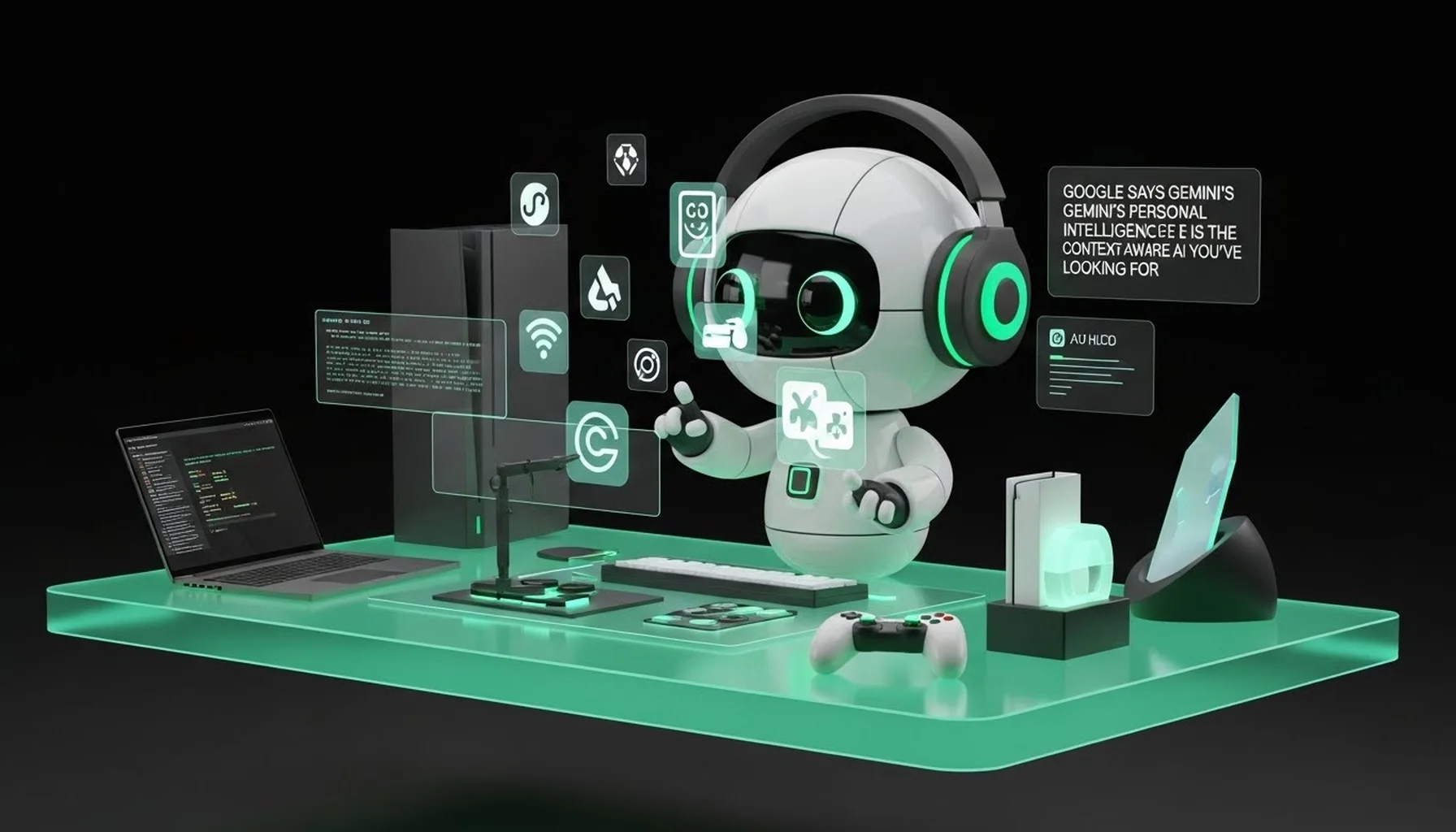
Google says Gemini’s Personal Intelligence is the context-aware AI you’ve been looking for
The Evolution of Artificial Intelligence: Introducing Gemini Personal Intelligence
We are currently witnessing a paradigm shift in the landscape of artificial intelligence. For years, the industry has chased the dream of a truly personalized digital assistant, one that moves beyond simple command-and-response interactions to become a proactive, helpful partner in our daily lives. Google’s recent announcement regarding Gemini Personal Intelligence represents the most significant step toward that reality to date. This is not merely an upgrade to the existing language model; it is a fundamental reimagining of how AI interfaces with human context.
The core promise of Gemini Personal Intelligence is its ability to understand the user deeply while rigorously adhering to privacy standards. It is designed to bridge the gap between vast computational power and intimate, individual needs. We have seen iterations of context-aware technology in the past, but they often felt clunky or invasive. Google claims to have solved this dichotomy by engineering a system that is both deeply intelligent and profoundly respectful of user boundaries. This technology promises to understand your workflow, your communication style, and your immediate needs without the user feeling the need to constantly reiterate their preferences.
For enthusiasts who appreciate the depth of technical customization—much like the community that powers the Magisk Module Repository—this development is fascinating. It represents a shift toward a more malleable, adaptable operating system environment where the software anticipates the user’s needs. In the same way that a custom-built environment optimizes for performance and utility, Gemini’s Personal Intelligence aims to optimize the cognitive load of the user by providing relevant, context-specific assistance.
Understanding the Core Architecture of Context-Aware AI
To truly appreciate the magnitude of Gemini Personal Intelligence, we must dissect what “context-aware” means in this specific architectural implementation. In previous generations of AI, context was often limited to the immediate text in a chat window or the last few seconds of audio. Gemini expands this context window to encompass the user’s digital ecosystem.
Beyond Simple Data Access
True context awareness is not about granting the AI blanket access to all user data. That is the model of the past, and it is one fraught with privacy concerns. Instead, Gemini Personal Intelligence utilizes advanced on-device processing capabilities. By leveraging the neural processing units (NPUs) found in modern smartphones and laptops, the model can understand patterns and preferences locally without sending that raw, sensitive data to the cloud.
This architectural choice is critical. It allows the AI to know, for instance, that when you say “remind me to buy this,” it understands which specific product you are looking at on your screen, who you are talking to, and the time of day, all without that information leaving your device. This is the private by design approach that users have been demanding. It transforms the device from a passive tool into an active participant that understands the nuances of your digital life.
The Interplay of Language and Environment
We are moving from a world where you ask an AI a question to a world where the AI understands the question you should ask. The Gemini Personal Intelligence system is designed to synthesize information from various inputs—text, voice, visual data from the camera, and screen context—to build a holistic model of the user’s intent.
For example, if a user is looking at a complicated recipe on a website, a standard AI might offer to read the ingredients. Gemini Personal Intelligence, understanding the user’s history of cooking on weekends or their preference for hands-free interaction in the kitchen, might proactively suggest adding ingredients to a shopping list or converting measurements. This level of assistance requires deep environmental understanding, not just linguistic fluency.
Privacy Nightmares vs. Intelligent Solutions: The On-Device Revolution
The phrase “without the privacy nightmares” is the cornerstone of Google’s marketing for this iteration of Gemini. We have all heard the horror stories of smart devices listening to conversations or cloud-based AI systems processing sensitive personal notes. The industry has reached an inflection point where trust is the primary currency. If an AI is to be truly personal, it must be trustworthy.
The Technicality of Trust
Google is leveraging a technology called Federated Learning and secure enclaves to make this possible. In simple terms, the AI model learns from the user without the raw data ever being exposed. The model updates itself on your device based on your usage, and only the learnings (not the data itself) are synced across your devices in an encrypted manner.
This approach mirrors the ethos we see in the open-source community, where transparency and control are paramount. Users who utilize tools found in the Magisk Module Repository often do so to gain granular control over their devices, stripping away bloatware and unwanted tracking. Gemini Personal Intelligence attempts to build that privacy directly into the AI architecture, offering a “Personal Data Enterprise” right in your pocket. It ensures that your calendar, your messages, and your search history remain your business alone, yet the utility of that data is made available to the assistant to help you.
Redefining Data Sovereignty
We are seeing a shift where the “intelligence” is no longer tethered to the “server.” By moving Personal Intelligence to the edge (the user’s device), Google is effectively creating a sovereign AI environment. This means that even if the internet connection is lost, the assistant remains fully functional because its knowledge of the user is stored locally.
This is a massive leap forward for reliability and privacy. It removes the latency associated with cloud processing and eliminates the risk of data interception during transit. For the security-conscious user, this is the only viable path forward for a truly integrated AI assistant.
Practical Applications of Gemini in Daily Workflows
The true test of any technology lies in its utility. How does Gemini Personal Intelligence change the day-to-day reality for a user? We anticipate a transformation in productivity and digital interaction that is comparable to the introduction of the smartphone itself.
Hyper-Personalized Search and Retrieval
Standard search engines rely on keywords. They are excellent at finding information based on what you type, but they often fail to grasp the why behind the search. Gemini’s Personal Intelligence introduces a “Memory” feature that is contextually active.
Imagine you are researching a specific technical problem for a project you started three months ago. A standard search engine treats every session as a blank slate. Gemini, however, understands the context of your project. It can recall the specific coding languages you were using, the error messages you encountered previously, and the documentation you found useful. It can then prioritize search results that are hyper-relevant to your specific technical environment. This reduces the time spent sifting through irrelevant results and increases the time spent solving problems.
Multimodal Interaction and Visual Context
We are moving beyond the keyboard. Gemini Personal Intelligence excels at multimodal inputs. This means you can point your camera at a piece of hardware, a document, or a physical object, and the AI understands what it is seeing in the context of your current activity.
For instance, in our work regarding Magisk Modules and system modification, one might encounter a complex boot loop issue. Instead of manually typing out obscure error codes, a user could simply show the screen to the device running Gemini. The AI, utilizing its local context of Android system architecture and the specific modules installed (assuming access via ADB or system logs), could suggest specific troubleshooting steps. It bridges the gap between the physical problem and the digital solution.
Seamless Cross-Device Continuity
The “Personal” aspect of the intelligence implies a continuity that spans devices. The context established on your phone instantly transfers to your laptop or tablet. If you are drafting a technical document on your desktop, and you need to leave for a meeting, you can switch to your phone and continue the interaction seamlessly.
The Gemini Personal Intelligence maintains the thread of the conversation and the background context. It knows you were writing about a specific module from the Magisk Module Repository, and it ensures that the files, references, and relevant web pages are accessible and highlighted on the new device. This eliminates the friction of context switching, allowing for a unified workflow regardless of the hardware being used.
The Technical Foundation: How Gemini Integrates with the OS
For the power user, the integration level of Gemini Personal Intelligence is where the magic happens. This is not a standalone app running in a sandbox; it is becoming a core subsystem of the operating system.
Deep System Hooks and Permissions
Unlike third-party launchers or assistants that operate with limited permissions, Gemini is being woven into the fabric of the OS. It has the potential to access system-level APIs that allow it to manage notifications, automate tasks, and interact with installed applications intelligently.
We are seeing the evolution of the AI layer as a primary interface for the operating system. Just as the Graphical User Interface (GUI) replaced the Command Line Interface (CLI) for most users, Context-Aware AI is poised to become the primary way users navigate the digital world. Instead of hunting for an app to perform a task, the user simply states the intent, and Gemini orchestrates the necessary apps and system processes to fulfill it.
Automation and Scripting Capabilities
For the modding community, the ability to automate the device is a key desire. We often see users utilizing Magisk Modules to trigger specific scripts based on system events. Gemini Personal Intelligence brings a natural language interface to this level of automation.
Users can create complex routines using natural language. For example: “When I connect my headphones after 9 PM, dim the screen to 30%, turn on Do Not Disturb, and open my audiobook app.” While this is possible now with apps like Tasker, it requires a steep learning curve. Gemini lowers that barrier to entry, allowing the AI to interpret the intent and generate the necessary automation rules in the background, bridging the gap between complex system capabilities and user-friendly interfaces.
Gemini and the Future of Open Source Communities
The announcement of Gemini Personal Intelligence also sparks a conversation within the open-source community. As AI becomes more integrated into the core OS, the questions of transparency and modifiability become more pressing.
The Role of Custom Modules
Communities centered around the Magisk Module Repository play a vital role in testing the boundaries of system capabilities. As Gemini evolves, we expect to see a parallel evolution of modules designed to enhance, modify, or extend the AI’s capabilities.
Whether it is bypassing regional restrictions for certain AI features, optimizing the AI’s resource usage for better battery life, or injecting custom data sources into the AI’s knowledge base, the open-source community will likely find ways to make Personal Intelligence even more powerful. The concept of “Personal” implies ownership, and for the advanced user, ownership implies the right to modify.
Privacy-Centric AI Development
We believe that the future of AI lies in open, auditable models. While Gemini is a proprietary product of Google, its move toward on-device processing is a win for the privacy-focused open-source movement. It sets a precedent that high-end AI does not require surrendering user data.
We anticipate that open-source developers will use the principles demonstrated by Gemini Personal Intelligence to build entirely open alternatives. This competition will drive the entire industry toward better privacy standards and more intuitive user experiences.
Conclusion: A New Era of Digital Companionship
We stand at the threshold of a new era where the distinction between “tool” and “companion” blurs. Google’s Gemini Personal Intelligence is not just another feature update; it is the realization of the context-aware AI that tech enthusiasts have been dreaming of for decades. It promises to handle the cognitive heavy lifting of digital life—managing information, anticipating needs, and bridging the gap between disparate data points—while rigorously protecting the sanctity of the user’s private data.
This is the context-aware AI we have been looking for because it respects our agency. It offers help without intrusion and understanding without surveillance. It transforms the smartphone from a window to the internet into a mirror of the user’s own mind, reflecting back the information and assistance needed precisely when it is required.
As we look toward a future where our digital environments become increasingly complex, the need for an intelligent, trustworthy curator becomes undeniable. Gemini Personal Intelligence aims to fill that role, providing a sophisticated, seamless, and private layer of intelligence that makes technology work for us, rather than the other way around. We are excited to see how this technology integrates into the daily lives of users and how the creative minds within the community will adapt to this new, intelligent landscape.